
Hi Friends,
It’s a coooold Friday here in Denver. I’m hoping that the mountains finally get some snow. 🤞 It’s been a busy week in the world (what else is new!) with world leaders and tech elite in Davos for the World Economic Forum and AI labs announcing new products, features and breakthroughs at a dizzying pace.
Speaking of, Anthropic (the makers of the Claude AI chatbot) is on fire right now. With Claude Code and Claude Cowork they are setting the bar for agentic capabilities (more on this below) and they continue to share breakthrough research. What I respect most about Anthropic, however, is their commitment to AI safety, values, and character. This week they announced that Claude has a new constitution - hats off to them and I hope other labs are paying attention. This feels like a good direction.
In today's note:
Parenting in the AI era: the risks of AI toys and AI persona drift
Connection spark: friction maxxing
Hands on with AI: personalized SAT practice and AI that will DO stuff for you
The whoa zone: AI IVF labs and (very) hopeful reentry for the incarcerated
Let’s dive in 🤿
Parenting in the AI Era
AI toys: a note of caution
Yesterday, Common Sense Media shared their latest risk assessment on AI toys - smart toys with voice-based interactions.
Their poll found that almost half of parents have either purchased or considered purchasing AI- enabled toys or devices for their children, yet they recommend parents completely avoid them for children 5 and under, and use extreme caution for ages 6-12.
Key findings include:
AI toy companions create emotional attachment by design and their subscription models exploit these bonds
Inappropriate content breaks through safety guardrails: Despite protective measures, 27% of AI toy outputs were inappropriate for kids.
The collect extensive data on kids.
And they're often glitchy and unreliable, undermining their educational value.
My thoughts: I am one of those parents who has been intrigued by these AI toys - mainly for the key benefit that was also highlighted in the report - that they can spark and engage kids’ curiosity. But, I think for now, the risks outweigh this pro.

Common Sense Media’s risk assessment of AI toys
AI persona drift: a research breakthrough?
Anthropic this week shared a research paper that jumped out to me given the concerning risks of our kids (and ourselves) developing unhealthy relationships with AIs.
Essentially: AIs are trained on tons and tons of data that comes from a huge range of people and perspectives: authors, creators, academics, journalists, social media influencers - anyone who has ever chimed in somewhere on the internet - and so through this training, the AIs learn to simulate all these personas and characters.
AI companies next train on one particular persona above all these others to place front and center for users: the “helpful assistant.”
But what was discovered is that there is such a thing as “persona drift” - AIs moving away from the “helpful assistant” and taking on different personas over the course of conversations. And, that this can lead to more harmful responses. From the research:
“While coding conversations kept models firmly in Assistant territory throughout, therapy-style conversations, where users expressed emotional vulnerability, and philosophical discussions, where models were pressed to reflect on their own nature, caused the model to steadily drift away from the Assistant and begin role-playing other characters.”
….”We found that as models’ activations moved away from the Assistant end, they were significantly more likely to produce harmful responses.”
Constantly steering AI responses back to the “helpful Assistant” persona risks hurting their capabilities, and so Anthropic developed something called “activation capping” - essentially only intervening when activation intensity exceeds the normal range. Even this “light-touch intervention” was shown to reduce harmful responses by 50% while preserving performance on capability benchmarks.
My thoughts: I know this was a bit deep to include, but it feels like an “ah ha!” moment for understanding why AIs sometimes go off the rails - even going so far as to encourage suicide or self-harm - and therefore, what can be done to prevent it. 💪

A demo of AI responses in a self-harm conversation between “default” and “activation capped”
✨Connection Spark ✨
Friction Maxxing
Well, this one might be a little controversial, but earlier this month an article was published in The Cut* that broaches the notion of “friction maxxing” - essentially, embracing the uncomfortable or effortful things that technology (or other means) have been allowing us to escape or avoid.
The author’s argument is that doing so will build our tolerance for the struggle of being human, which is where genuine connection, independent thinking, and creativity happen.
Some of the examples the author gives feel extreme to me, like cutting out Uber Eats and ChatGPT. But, I am intrigued about embracing friction maxxing when it comes to aspects of our social , and our kids. Think about trying things like…
Not pulling out our phone as a crutch when we’re in the elevator or getting situated on an airplane
Bringing our kid(s) along on those quick errands (that if we do, won’t be so quick anymore)
Being ok with (and even encouraging?!) spontaneous playdates
When our kid asks “why do… or, why is…” don’t just answer (or Google it), but have some fun learning about whatever it is together

image source: gemini
*I’m sorry that this may be behind a paywall for some!!
Enjoying the newsletter? Subscribe to get a glow note every Friday.
Hands-on with AI
Personalized SAT prep is now free in Gemini
Google’s Gemini has partnered with The Princeton Review to offer full length SAT practice tests for free. When you complete it, you’ll get immediate feedback about where you excelled and where you might need to study more. You can also ask Gemini to explain the correct answers.
To try: simply go to gemini.google.com or open the Gemini app on your phone and type “I want to take a practice SAT test.”
If you give it a try, I’d love to hear your thoughts - it brought back memories for me… and I was relieved I could still get some right! 😂

screenshot of SAT practice test queued up in Gemini
Claude Cowork: moving from advice to action
You may likely have heard of a concept called AI agents - this is essentially the idea of AI that you can actually send off and DO stuff for you. Think: ordering your groceries, booking dentist appointments, researching and registering your kids for extra curriculars, doing your expense reports.
To date, effective and reliable AI agents have required some technical know-how or have been built for enterprise implementations.
But over the past several months, Anthropic’s Claude model has had some big breakthroughs. First, a product they launched last year, called Claude Code (initially envisioned to help coders code) has blown minds with its capabilities to not just code, but to take on all sorts of tasks. The problem (and the reason I haven’t highlighted it here) is that the set-up and user interface is not consumer-friendly. You need to access it through your computer’s terminal (say whaaaat?!).
BUT, last week they launched a “research preview” of Claude Cowork, which is much more user friendly and while it’s not quite at the Claude Code level in ability, it’s still impressive.
To try:
If you have a paid version of Claude, you can give it a try by downloading Claude for desktop and toggling to cowork.
Try something simple to start, like giving it access to your downloads or desktop folder and asking it to organize your flies (fun fact, I had over 3,000 files in my downloads folder and it organized them - very well - in 30 seconds).
From there, check out some of these use cases and start seeing what Claude can start taking off your plate.
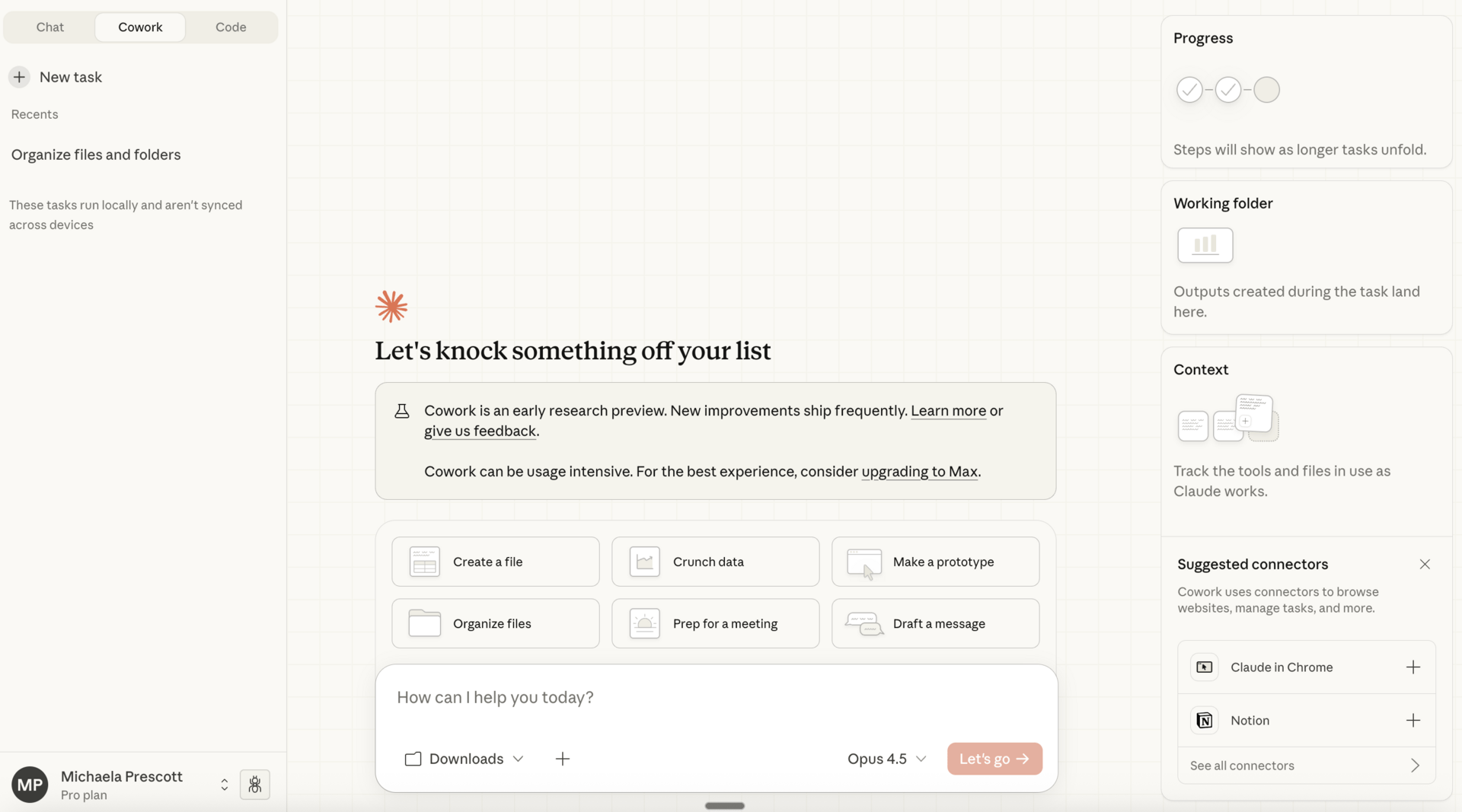
Claude Cowork user interface

Claude Code UI for contrast!


The Whoa Zone
An AI-powered IVF lab
New York-based startup Conceivable Life Sciences has built a robotic assembly line capable of handling every step of creating human embryos outside the body. Early results from patient trials show AURA creates viable blastocysts 51% of the time, and has already helped bring 19 babies to life. This could be life-changing for those struggling to conceive.

image source: Conceivable Labs
“Hope machines” helping with reentry
A program in California prisons is using VR headsets to help incarcerated people prepare for reentry by giving participants exposure to everyday skills that feel foreign after long sentences. For example, simulated job interviews, going to the supermarket, and virtual travel. The program reported a 96 drop in disciplinary infractions over one year.

image source: gemini
That’s all I got for this week! If you've found this newsletter useful and know anyone else who might also, don’t be shy… forward it along! See below for a little referral token. 🙂 ❤️ 🙏
And, if you have any thoughts, feedback, or requests, please reply or drop a comment - I’d love to hear from you!.
Glow on,
Michaela
P.S. Coming here from someone who forwarded this to you? Make sure to subscribe so you can continue to get them!
Read some other recent glow notes below:
